
Tower and Town, November 2026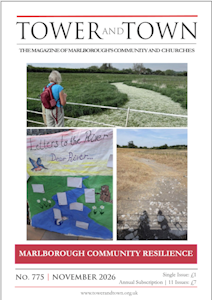 (view the full edition) On BioRegions: The History Of An IdeaBioregions and bioregioning grew out of the environmental movement of the late 1960s and early 1970s in California. A key figure was Peter Berg, a former San Francisco Digger who, after traveling across the country and witnessing environmental destruction firsthand, founded the Planet Drum Foundation in 1973. Berg and his collaborators were searching for a way to "reinhabit" places - and to live as if the land and water actually mattered, rather than treating land as real estate that could be delimited by lines on maps. Their foundational text was titled “Reinhabiting California” and coauthored by Berg and the ecologist Raymond Dasmann (Berg & Dasmann, 1977). Their article is widely considered one of the founding moments of "bioregionalism". Dasmann's work on Indigenous peoples and their relationship to both land and ecosystems was a major influence on their thinking. A bioregion is most simply a region defined by its biology, and very often, by the watershed of the river which flows through the land. The Bioregion is intimately linked to and reflects the lie of the land. In practice, bioregional thinking helps us relate to our river as a living system that we belong to. This naturally enhances our awareness of the way in which the river flows through the land. In Britain, the term catchment is often employed. This term carries a slightly different meaning to watershed, in that it can refer to an area collecting water for a specific river, reservoir, or aquifer. This may or may not align with a watershed, defined by topography and the lie of the land. Bioregionalism also implies a shift towards local self-sufficiency. A "bioregional economy" is thus one where production is oriented toward the community's needs within the region's ecological limits. This contrasts with the “global economy”, which not only ignores ecological boundaries, but often leads to impoverishment of the land. When we cross the bridge over our river, we might ask ourselves how well we know our watershed? Do we know where the water comes from? Do we know where it flows? As Berg and Dasmann put it, “it involves becoming fully alive in and with a place. It involves applying for membership of a biotic community and ceasing to be its exploiter.” That awareness is the beginning of bioregional thinking. Reference: Berg, P. and Dasmann, R. (1977). "Reinhabiting California." The Ecologist, 7(10), 399-401. Dr Pete Jeffs<br>October 2026 |