
Tower and Town, June 2026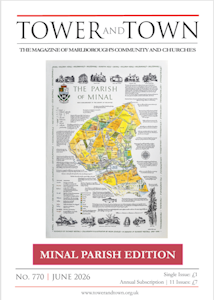 (view the full edition) (view the full edition)The Parish Of MinalIn the Dark Ages, there were three centres. Bedwyn was the old cultural centre of the district as well as being at the heart of the Royal estates. Ramsbury was the ecclesiastical focus and has a bishopric dating to 909 AD. And the small town of Marleburg (Marlborough) was the commercial centre and main market. The parish of Mildenhall was roughly in the centre of these three, but when the Roman centre of Cunetio became deserted in about 450 AD, Mildenhall became less important as a geographical place and instead developed as a large prosperous farming and milling community. Minal Parish now occupies approximately 4,180 acres. Within the parish there are two other large hamlets, Stitchcombe and Poulton. Both were important enough to feature in the Domesday Survey of 1086. By the 16th century several large farm communities had been established. The Marlborough Downs rise to 700 feet in the north, while the plateau of Savernake Forest to the south is 600 feet. The River Kennet divides these two features, relentlessly cutting through the soft chalk to create the iconic valley below. Although commonly called Minal, the proper name of the parish and the village is Mildenhall. The earliest record comes from Saxon times when it was Mildenhald, and the Carlularium Saxonicum gave this spelling. The Domesday Survey of 1086 gave the name as Mildenhalle but in 1282 the Charter Rolls called it Mildehale. Other versions followed. About 1760, a new form, that of Minal, was being used. It is very possible that the difficulty of dealing with the three syllables of Mil-den-hall was too much for the local folk who may never have seen the name written down. They slurred the three syllables together to sound something like "Minorl" which was easier to say, and this in turn, became known as Minal. As with many ancient parishes, local names abound. Cock-a-Troop, possibly associated with a signal station or look-out, follows the Roman road south towards Winchester. Another piece of the Roman way is named Greenway. It is said that village people cut wood on Chopping Knife Lane. The strangely named hamlet of Werg was a community of nine dwellings on the River Kennet. Amity Oak is a tree in Savernake Forest which marks 3 parish borders: Minal, Little Bedwyn and Brimslayed-Cadley (now Savernake). At Whiteshard Bottom 4 parishes meet - Minal, Ogbourne St. George, Aldbourne, and Ramsbury, with Ogbourne St. Andrew joining nearby. Mills: The Kennet powered three mills between 1773 and 1924 - Werg, Durnsford and Stitchcombe with one on the Og at Poulton. Adapted from the Parish Website |